I’m Abi Jameson, the Primary School’s Work Facilitator for the charity, ACTS (Active Christian in Thanet Schools) in Kent. We work with over twenty local primary schools, resourcing them to explore issues of faith and spirituality. In December, we ran our first ever prayer space for children in a specialist setting.
Whilst we have had a lot of experience running prayer spaces in mainstream schools, bringing a space into a dedicated SEN setting was new to us. At this particular school, all the children have either a diagnosis of autism or speech and language difficulties. Therefore, when we planned the activities, it was important to engage closely with the school about what would be appropriate.
When planning the space, I kept several things in mind:
As a charity, we are lucky enough to have a good base of volunteers, and several came forward to help run this prayer space as they had personal experience of working with children with autism. Their insights were invaluable, and they played a key role in gently engaging each child that came into the space.
The day itself was really positive. It was truly special to see how each child engaged with prayer and reflection in their own way. The pupils came into the space either very unsure and wary, or totally excited and running around. After some time, it was wonderful to see how they opened up about faith and their feelings when they were engaged with the activities.
One child spent the whole time in the space, turning on the tea lights and carefully placing them on the map, till the whole world was lit up! I commented that for Christians, Jesus is the light of the world. The pupil looked at me and simply said, “Yes, he is. He made the light.”
Similarly, a child who came into the space very unsure, spent a long time playing with the alphabet tiles. One of our volunteers came alongside him and simply copied what he was doing. After ten minutes, the child relaxed and our volunteer asked him what he thought God might be like. Without saying a word, the child used the tiles to spell out, “helps my anxiety”. A really powerful moment.
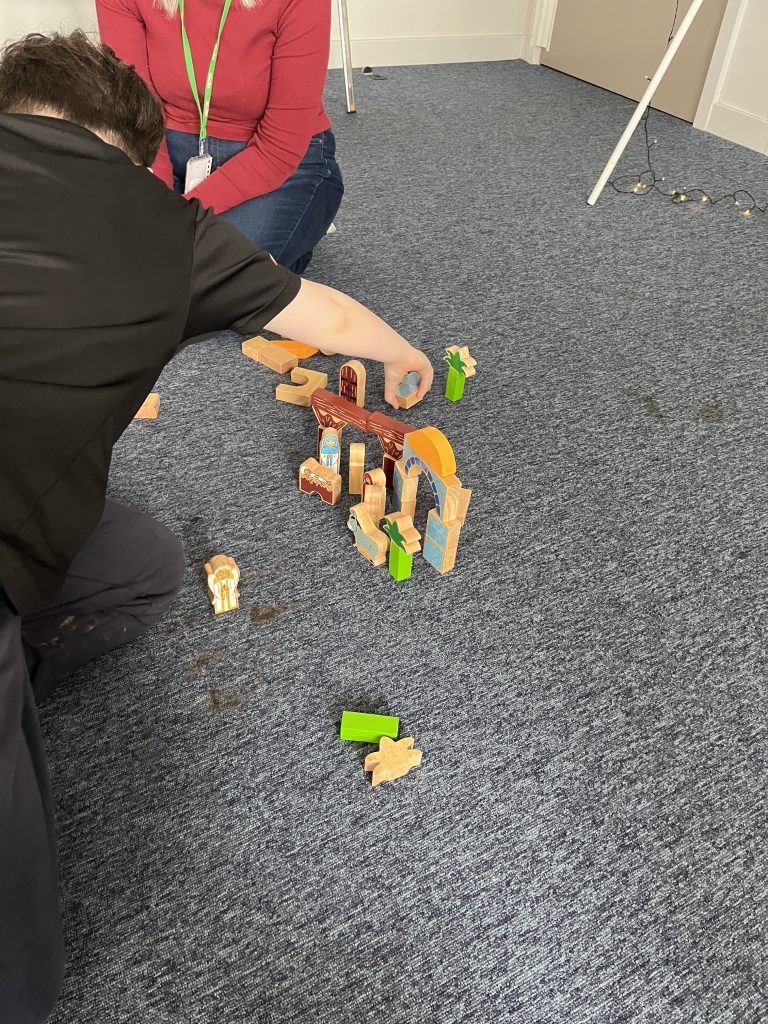
When I planned the space, I wanted to make sure that there were areas of play, as well as areas of reflection. One of the most popular activities was a set of nativity blocks. Pupils of all ages sat and built the stable, positioning the characters around the manger. I asked one of the pupils why they thought Jesus was born in a stable. They responded with, “because God has a choice. He would choose a stable.”
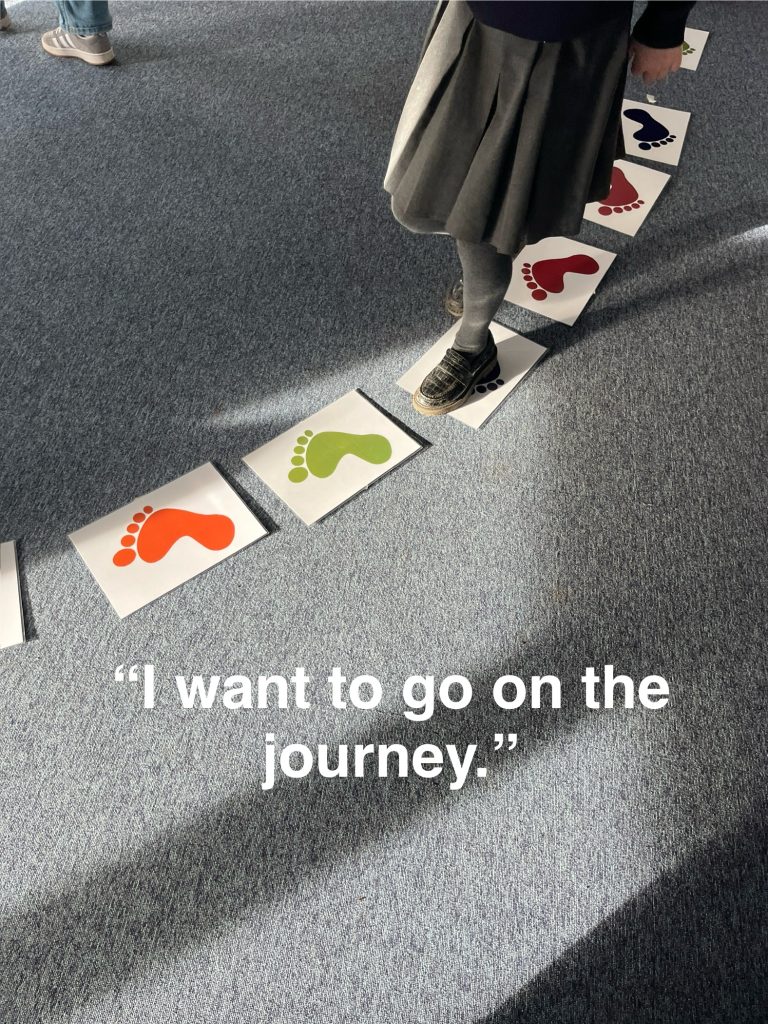
Another popular play-style activity was a set of footprints we placed around the room. The pupils were encouraged to go on a journey from one footprint to the other, thinking about the journey to Bethlehem. A physical activity like this was really engaging for some of the pupils and it was brilliant to hear them shouting, “I want to go on a journey too.”
By far the most popular activity in the room was the hand shredder. The children really enjoyed drawing their worries on the paper and then turning the handle and watching them disappear. One of the teachers commented that not only was it visually appealing for the pupils, but the shredder itself provided great sensory feedback when turned.
As a team, we learnt a lot from our day in this school. Firstly, that the pupils would engage with the activities in a way that made sense to them. We modelled and wrote instructions, but it was more impactful for the children to do what they felt, rather than for us to try and specify. An example of this was a pre-verbal child in one of the younger classes. She found it hard to settle to anything until we showed her the manger and the baby Jesus model. She then spent the rest of her time using the cloth strips to make the manger soft whilst also offering him the plastic hearts we had for a different activity. It was really moving to see her taking care of Jesus in this way.
The other thing we found useful early on, was to come alongside the children and do the activities ourselves. In that way, we were working parallel with the pupils and it seemed to remove any sense of threat and open up more conversations. In many respects, the activity simply created a way-in, to start talking about faith and their understanding of God.
The feedback from the school was really positive, with many teachers commenting on how calm the space felt, and how engaged the children had been. Several children did not want to leave the space, particularly if they had not completed every single activity! The best comment of the day though came when I told the children at the start of the session that this was their space where they could reflect and talk to God if they wanted to. One boy looked at me and said, with sheer delight, “We can talk to God?! Right here?!”